
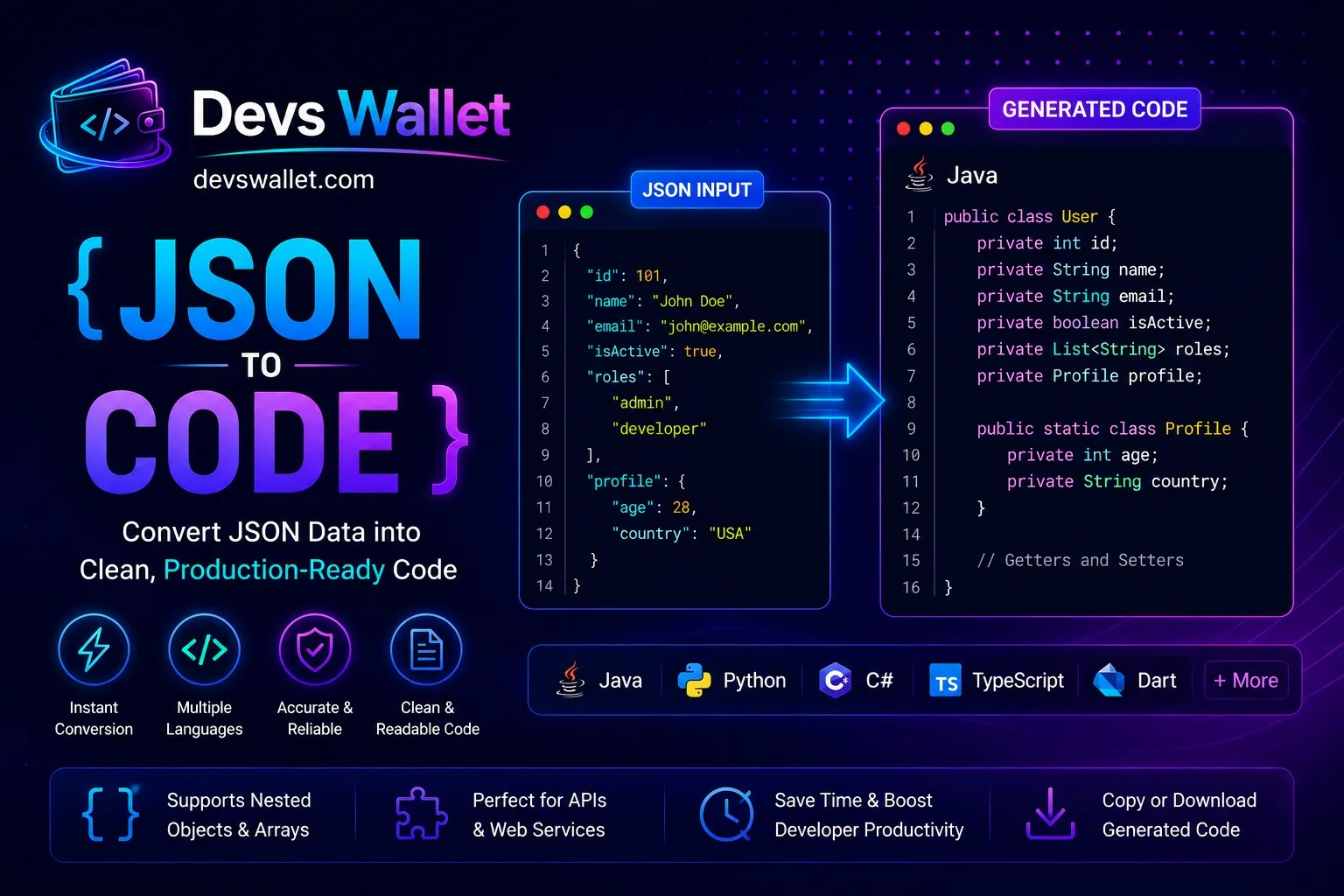
Need json to typescript done in the next five minutes? You can do it in the browser with JSON to Code.
This guide is a how to. You will open JSON to Code, run a small sample named json_to_code_sample_71, then run your real file.
The voice stays simple. Sentences stay short. You stay in control of what you paste. DevsWallet is for the United States audience that wants a calm json to typescript walkthrough, not a sales pitch.
Start tiny. If the tiny sample works, your big file has a better chance.
What you get from this JSON to Code guide
By the end you can explain JSON to Code to a teammate in one minute. You will know the main button, the sample file name json_to_code_sample_71, and the first error to expect.
You will also know when JSON to Code is the wrong tool. That saves time. A wrong converter can eat an afternoon.
- Open JSON to Code from /tools/json-to-code.
- Run json to typescript on a tiny sample first.
- Copy or download the result and store it next to your source file.
- Link this guide at devswallet.com/blog/json-to-code in your runbook.
You do the review. DevsWallet does not hide warnings. If the page shows a red note, stop and fix the input.
How JSON to Code changes json to typescript from one format to another
JSON to Code lives in the Formatting group on DevsWallet. Tagline: Types from JSON.
A converter such as JSON to Code maps one shape to another. JSON to Code cannot guess missing fields. If json to typescript is messy, the JSON to Code output will be messy too.
Paste JSON. Generate TypeScript types. Optional fields depend on nulls. Rename roots to match your app.
You work in English (US) on this page. Labels are in plain words. If a control is optional, the page says so. You can ignore optional boxes on the first run.
What JSON to Code is not
JSON to Code is not a hosted backend for your company. It is not legal advice. It is not a place to store customer databases. Use it for samples, teaching, and quick jobs.
When JSON to Code is the right converter
Use JSON to Code when you need json to typescript in a browser and you can review the output yourself.
- You are on a laptop that blocks random installers.
- You want to show a teammate the click path on a call.
- You need a second opinion before you change production data.
- You are learning json to typescript and want a safe sandbox.
Skip JSON to Code when the file is classified, when a policy forbids web tools, or when you need a signed SLA.
Also skip it when the job is a million rows. Browsers freeze. Split the work. Or use a script you own after JSON to Code taught you the settings.
Files and samples to keep nearby
Have these nearby before you click Convert.
- A tiny sample named json_to_code_sample_71. Keep it under a few kilobytes if you can.
- A note of the encoding or delimiter your source system uses.
- A place to save output, such as a folder named json to code out.
- A second device or phone if you must scan a QR or read an OTP.
- The Privacy Policy if the sample includes personal data.
If you cannot redact names, stop. Make a fake sample. JSON to Code still teaches the clicks. Fake data is easier to share in tickets.
Open JSON to Code without installing software
Go to https://devswallet.com/tools/json-to-code. Confirm the heading says JSON to Code.
If you landed on a category page, use search. Type json to typescript. Open the card. Bookmark the tool URL, not a search result, so you do not grab the wrong cousin tool.
DevsWallet also lists this write up at https://devswallet.com/blog/json-to-code. Keep both tabs: one for the tool, one for this guide.
Check your browser zoom. The layout is built for a normal desktop width. A very small phone works for tiny jobs. Large files prefer a computer.
Convert with JSON to Code step by step
Do this in order. Do not skip the tiny sample even if you feel busy.
- Upload or paste the source for json to typescript.
- Set format options if you see them (delimiter, page range, image type).
- Click Convert. Wait if a worker bar appears.
- Download the result. Open it in the real app (Word, a browser, an IDE).
- Compare three facts: title, a number, and a date. If those survive, the rest is likely OK.
If the page spins
Worker tools (PDF, OCR, speech, video) need time. Stay on the tab. If it fails, shrink the file. Then retry once. Three retries with the same huge file waste the afternoon.
One retry, then shrink the file
If JSON to Code fails twice on the same huge input, the file is the problem. Cut json_to_code_sample_71 down, click Convert again, then grow the job.
If you need a teammate
Send the tool link https://devswallet.com/tools/json-to-code plus your sample name json_to_code_sample_71. Do not send production passwords.
Copy this JSON to Code conversion example
Pretend you are helping a US teammate named Alex. Alex has a file called json_to_code_sample_71. The goal is json to typescript before lunch.
Run the tiny sample first
You open JSON to Code. You paste only the first record or the first page. You click Convert. You get a result you can explain in two sentences.
Write those two sentences in the ticket. Example: "I ran JSON to Code on json_to_code_sample_71. Output matched the number 42 and the date 2026-03-12." That is a useful note. "It worked" is not.
Then run the real file
Then you run the full file. If the full file fails, you already know the tool path is fine. The data is the issue.
Keep json_to_code_sample_71 in a folder of golden samples. Next month, when JSON to Code gets a UI tweak, you re run the same file. That is how you avoid surprises.
JSON to Code options that change the file
Here is a compact map of JSON to Code. Labels may shift slightly, but the jobs stay the same.
| Control | What it is for | Note |
|---|---|---|
| Upload / paste | Source file | Keep a backup |
| Output type | Target format | Match the next app |
| Download | Saves to disk | Open it outside the browser |
If a control is missing, you are on a smaller screen. Open the advanced row. Or rotate the phone. Do not assume a missing box means the feature is gone.
Conversion bugs people hit in JSON to Code
You pasted production secrets
Close the tab. Rotate the token. JSON to Code is the wrong vault. Use a password manager.
You trusted minify as a backup
Minify is not a backup. Keep pretty source in git. JSON to Code can minify for the CDN, not for history.
You ignored the first error
Parsers stop early. The tenth error might be fake until you fix the first comma.
You compared the wrong cousin tool
DevsWallet has related formatting tools. JSON to Code is for json to typescript. A nearby card may look similar. Read the slug in the URL.
- Empty output: check clipboard permissions and that the box is not filtered by an extension.
- Weird characters: check UTF-8 vs Windows-1252.
- Slow run: shrink the file. Close extra tabs.
- Mobile copy fail: email the file to yourself or use desktop.
Safe handling of json to typescript during convert
Some DevsWallet tools run in your browser. Some send heavy jobs to a worker. Read the note near the submit button on JSON to Code.
Do not upload health records, tax IDs, or private keys unless you accept the risk. Privacy Policy and Cookie Policy explain cookies and ads.
You are still responsible for what you paste into JSON to Code. A local looking box can still be on a shared laptop. Clear the JSON to Code field when you walk away.
Ads on DevsWallet follow Google AdSense rules. This JSON to Code guide does not ask you to click ads. It asks you to finish json to typescript and leave with a file you trust.
Pair JSON to Code with other DevsWallet tools
After JSON to Code, chain a second step instead of bouncing to random sites.
- Base64 Encoder: Encode & decode Base64
- CSS Minifier: Shrink stylesheets
- CSV to XML: CSV rows to XML
- CSV ⇄ JSON: Convert between formats
- Compress PDF: Shrink PDF file size
Company pages: About, editorial policy, contact.
Using JSON to Code when production is already on fire
Do not debate tools in the json to typescript channel. This page already chose JSON to Code at /tools/json-to-code.
If JSON to Code is down, say json to code is down. Switch to a local script you already trust. Do not shop random json to typescript sites.
Afterward, attach redacted json_to_code_sample_71 from JSON to Code. That turns the Formatting war story into a test case.
Blameless note for JSON to Code: "We skipped json_to_code_sample_71" is more useful than "JSON to Code is bad".
If a banner distracted someone during JSON to Code, full screen /tools/json-to-code next time.
Rotate any token that appeared on a shared Zoom of JSON to Code while json to typescript was on screen.
Update the JSON to Code runbook the same day. Wait until Monday twins the json to code incident.
Then go home. json to typescript on JSON to Code will still be there tomorrow. Sleep is part of json to code quality.
Incidents involving json to typescript feel loud. JSON to Code can still be quiet. Use a copy of json_to_code_sample_71, never the only original.
During a JSON to Code incident, appoint a scribe. They record JSON to Code settings. You click Convert.
A simple desk ritual for JSON to Code
When the JSON to Code ritual breaks, it is usually a new laptop missing the /tools/json-to-code bookmark.
Write the JSON to Code ritual in the wiki with slug json to code so contractors match staff on json to typescript.
Set up a desk ritual for JSON to Code only. Same browser profile. Same folder named json to code desk. Same file json_to_code_sample_71.
Put the JSON to Code folder above Downloads so json_to_code_sample_71_ok does not vanish into a pile.
Pin JSON to Code next to your editor. One click to json to typescript beats searching json to code every time.
json to typescript on JSON to Code goes faster when the ritual is dull. Excitement is for the product, not this Formatting step.
If you share a desk, log out of DevsWallet after JSON to Code. Idle json to typescript samples should not sit in the box.
Sticky note for JSON to Code: "Convert then save json_to_code_sample_71_ok". That is the json to code ritual.
US and UK keyboards both run JSON to Code. Quotes differ. If json to typescript fails, check the quote character in json_to_code_sample_71.
Types from JSON is the JSON to Code promise. Do not ask JSON to Code to be a mail server.
Key takeaways for JSON to Code
- Open JSON to Code and run json_to_code_sample_71 first.
- Read errors from the top.
- Save output next to the source file.
- Never paste secrets you cannot rotate.
- Link this guide in your team doc.
Remember: On JSON to Code, run json_to_code_sample_71 first. Then the real file. Then save.
FAQ about JSON to Code
Is JSON to Code free to use?
Yes. Everyday json to typescript on DevsWallet at https://devswallet.com/tools/json-to-code is free. If a heavy worker later needs a cap, the JSON to Code page will say so first.
Does JSON to Code work on a phone?
Small json to typescript jobs on JSON to Code work on a phone. Large formatting files are easier on a computer with json_to_code_sample_71 saved locally.
Where does my JSON to Code file go?
Read the privacy note on JSON to Code. Browser only json to typescript stays on your device. Worker jobs send only what JSON to Code needs. Still skip regulated data.
Can I automate JSON to Code in CI?
The JSON to Code page is for people. Prototype json to typescript here with json_to_code_sample_71. Then put the stable steps in your own script. Do not scrape /tools/json-to-code.
How do I report a JSON to Code bug?
Use contact. Send browser name, json_to_code_sample_71 (redacted), the slug json to code, and what you expected from JSON to Code.
Can I use JSON to Code output commercially?
You own your json to typescript data. JSON to Code does not claim your file. Respect other people's copyrights if you converted their documents in JSON to Code.
Why did JSON to Code disagree with another app?
For json to typescript, check encoding, time zones, delimiter, and metadata stripping. Run both apps on json_to_code_sample_71 from JSON to Code.
Who writes the JSON to Code guide?
DevsWallet editorial. See editorial policy. This page is a how to for JSON to Code at https://devswallet.com/blog/json-to-code, not a ranking contest.
Close the loop on JSON to Code
You now have a path: open JSON to Code, run json_to_code_sample_71, then run the real job. Keep this tab until the file is saved.
If something on the page is unclear, write to contact. Bring the slug json to code so we can find the right screen.
Last updated: September 2026. Author: DevsWallet Editorial.